The Highlands had a way of making discomfort feel ok.
At two in the morning, crammed into the back of my estate car with a sleeping bag twisted around my legs and condensation dripping steadily from the windows, I was less convinced of that truth than I had been when Will and I first planned the trip. Every joint in my body ached. The cold had found its way through every layer I owned, and somewhere outside in the darkness, rain whispered across the roof in waves.
Still, when the alarm of the bellowing highland stags sounded, I was smiling.
That was the strange magic of Scotland.
We were deep into the west Highlands on what could generously be called a budget photography expedition. In reality, it was two photographers sleeping in cars, surviving on petrol station sandwiches and supermarket coffee while trying to build the foundations for a future photo-tour business. The plan was simple enough: scout locations, photograph as much as possible, and figure out whether we could realistically guide others through landscapes we so enjoy ourselves.
Every day also felt important and by this point we were a few days in.
That morning began with red deer. Mist hung low across the glen like smoke drifting from an unseen fire, turning the landscape pale and dreamlike. This wasn’t unusual of the highlands. We had spent hours slowly moving through the cold, speaking only in whispers as small groups of deer appeared and disappeared between folds in the hills. The stags stood motionless in the haze, watching us with ancient patience.
Will was in his element. Even in terrible conditions he carried himself with the calm confidence of someone who could already see the finished image in his head before lifting the camera. I envied that sometimes. My mind wandered too much. I was forever distracted by movement, by atmosphere, by the possibility that something unexpected might happen just outside the frame.
By mid-morning, soaked, hungry and with a handful of images, we gave up on the deer and drove toward one of Glencoe’s famous photography spots for coffee.
Tourists were already gathering despite the weather. Cars lined the roadside. Tripods stood in puddles like metallic herons. The Highlands had become something of a pilgrimage site for photographers over the years, and this location was among the most recognisable of them all. Therefore a challenge to come away with anything not seen before.
Will leaned against the boot of his car with steaming coffee in hand and surveyed the mountains disappearing into cloud.
“Could be good later if the light breaks,” he said.
“Could be,” I replied.
But I wasn’t really listening. I was fully invested at this point in just enjoying my coffee.
A short walk later we noticed a raven. Given away by two small darks, barking as the raven teased them just beyond the confinement of their leads.
It moved along the riverbank with a strange sideways confidence, picking through the remains left behind by campers from the previous night. Black feathers shimmered blue in the dim light whenever it turned its head. Ravens always looked intelligent to me, almost as though they understood more about the world than they should.
We had come out specifically for landscapes that session and it was clear that that was the mission.
I only carried a single lens: my trust 24–105mm wide-angle setup, better suited for mountains and waterfalls than wildlife. My longer lens remained buried back in the car because I had been determined, for once, to focus entirely on landscapes. But wildlife photography has a way of creeping back into your bloodstream.
Will wandered off toward the famous composition with purposeful determination, camera strap slung over his shoulder.
I stayed with the raven.
The river moved quietly beside us, babbling over dark stones. Low cloud dragged itself across the mountains so heavily it felt as though the entire glen had been pulled beneath a blanket. Somewhere farther away I could hear shutters firing in bursts as wedding photographers captured the classic scene again and again.
Meanwhile the raven hopped from stone to stone completely uninterested in any of it.
I crouched lower, desperately trying to achieve something thoughtful with such a small focal distance. The dogs now barking more than ever.
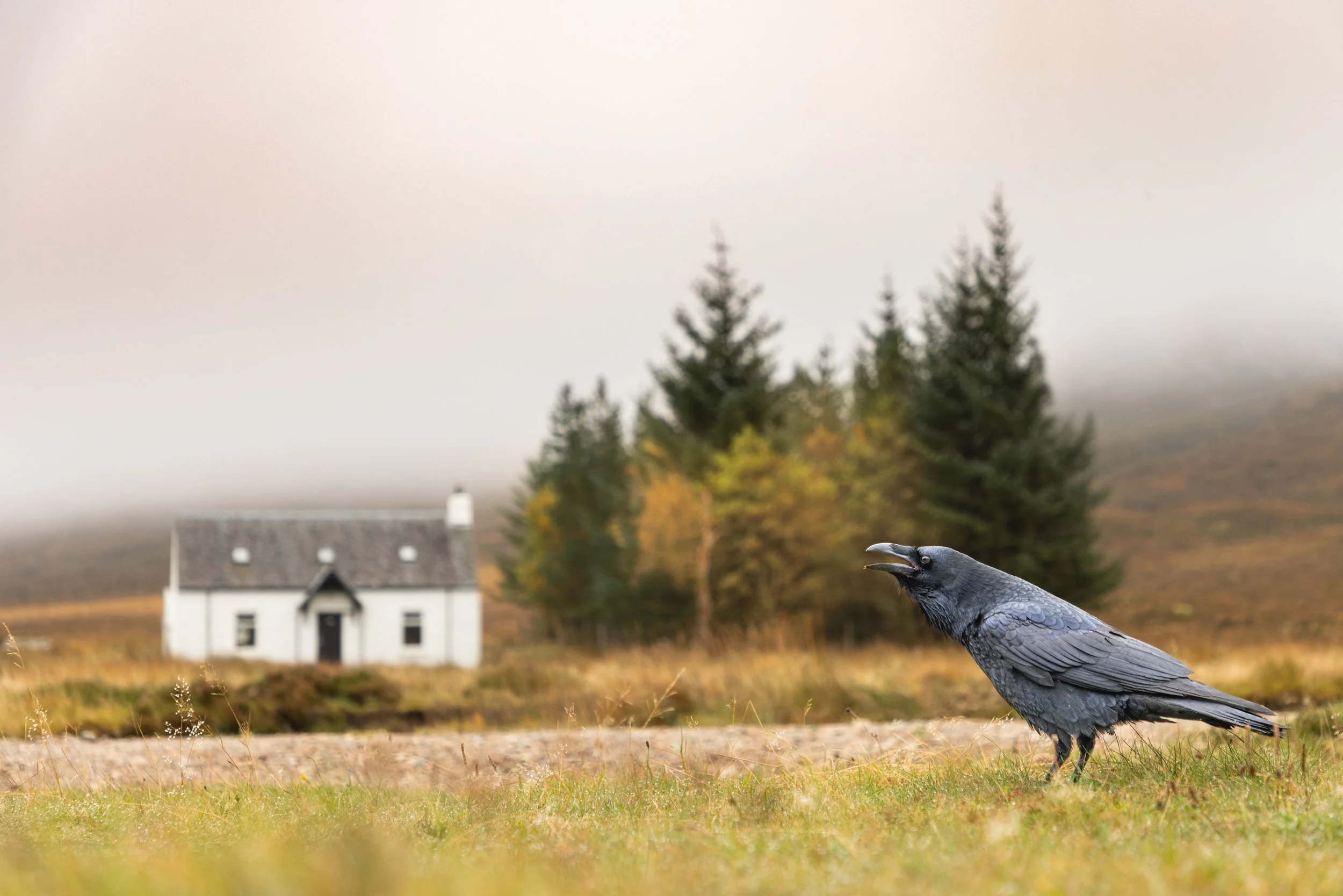
The bird edged closer toward the old white cottage sitting alone beneath the mountains and suddenly the composition appeared.
Gradually and thoughtfully, the composition arrived.
The raven. The cottage. The empty space between them.
The focal length was far from ideal, forcing me to think differently. Instead of filling the frame with the bird, I allowed the surrounding landscape to breathe. The cottage sat isolated beneath the heavy sky while the raven remained small but deliberate in the foreground.
Negative space, interesting subject and drama. Just what I love in an image.
Then the raven opened its beak and called with a sound that cut through the glen. I fired the shutter.
Again.
Again.
The raven continued calling, turning slightly toward the cottage as if demanding an answer from whoever might be hiding inside.
The low cloud deepened the mood. The cottage looked abandoned beneath the mountains, vulnerable against the immense scale of Glencoe. Even the river seemed subdued, carrying silence downstream.
Eventually the raven stopped, hopped and moved out of the scene. Just like that, the moment was over.
I lowered the camera to check the images immediately.
Across the glen, Will was still working the landscape compositions.
We spent the next couple of hours searching for compositions around Glencoe, following rivers, climbing wet hillsides, stopping whenever the cloud shifted enough to reveal light on the mountains, before heading over to the Isle of Mull for a few days.
I think about that morning whenever conversations about photography become too focused on equipment, locations, or social media trends. Because the truth is, I nearly missed the image entirely.
I had convinced myself the day was supposed to be about landscapes. I had carried the “wrong” lens for wildlife.
I had every practical reason to ignore the raven, but we already know, photography rarely rewards rigid plans. Sometimes the best thing you can do is pay attention when something unexpected asks to be seen.