When Knowledge and Luck Come Together
There are some wildlife encounters that stay with you not because they resulted in the perfect image, but because everything came together in just the right way. The light might not have been perfect, the animal might not have given you the pose you had imagined, and the resulting image may never become the one you consider your finest work. Yet, years later, you can still remember exactly where you were, who you were with, and the feeling of watching a wild animal appear almost as if it had been arranged especially for you.
This is one of those moments.
It was during my first year of running photography workshops on the Isle of Mull. I was still finding my feet with the workshops and learning the rhythm of working on the island, but Mull was already teaching me one of the most important lessons in wildlife photography: sometimes the best way to find an animal is simply to pay attention to the clues it leaves behind.
On this particular occasion, we'd been exploring a stretch of shoreline when I started noticing otter spraint on some of the boulders. It wasn't just one isolated sign, either. There were several deposits in the area, and that immediately caught my attention. Spraint is one of those little details that can easily be overlooked if you're simply walking along looking for an animal, but to me it was a sign that this stretch of coast was being used by otters.
Of course, finding evidence that an otter has been somewhere and actually seeing one are two very different things.
An otter could have passed through hours earlier. It might have been hunting somewhere along the coast, resting out of sight, or simply chosen to travel along a different section of shoreline that day. There are no guarantees in wildlife photography, and certainly no promises that an animal will appear simply because you have brought a camera.
But the signs were there.
So I suggested to my friend and workshop participant that we sit down and wait.
There was no elaborate hide, no carefully constructed setup and no expectation that something would definitely happen. We simply found a comfortable spot in the grass, settled down and waited. And then, rather than spending the entire time staring intently at the water, we relaxed.
We chatted.
We ate some food.
We enjoyed being outside.
And, perhaps most importantly, we gave ourselves time.
That is something I have come to appreciate more and more about wildlife photography. We can become so focused on getting the photograph that we forget to enjoy the experience itself. Sitting quietly on Mull, surrounded by the landscape, with no pressure to make anything happen, was part of the experience.
Then, suddenly, there it was.
An otter came swimming up along the shoreline.
There is something wonderfully understated about the way otters can appear. One moment the coast seems empty, and the next there is a dark head moving through the water, steadily making its way towards you. After all that waiting, this one wasn't heading away from us or disappearing around the next headland. It was coming our way.
We watched as it continued along the shoreline before eventually leaving the water and walking up onto the beach.
And then it did something that still makes me smile whenever I think about the encounter.
It simply walked straight past us.
There was no dramatic pose. No perfectly timed yawn. No spectacular leap from the water. No textbook wildlife photograph.
It just carried on with its day.
And that, in many ways, made the encounter even better.
We had been sitting there eating and chatting, waiting to see whether anything might appear, and eventually an otter had arrived and casually wandered past as though we were simply another part of the landscape.
Of course, the cameras came up.
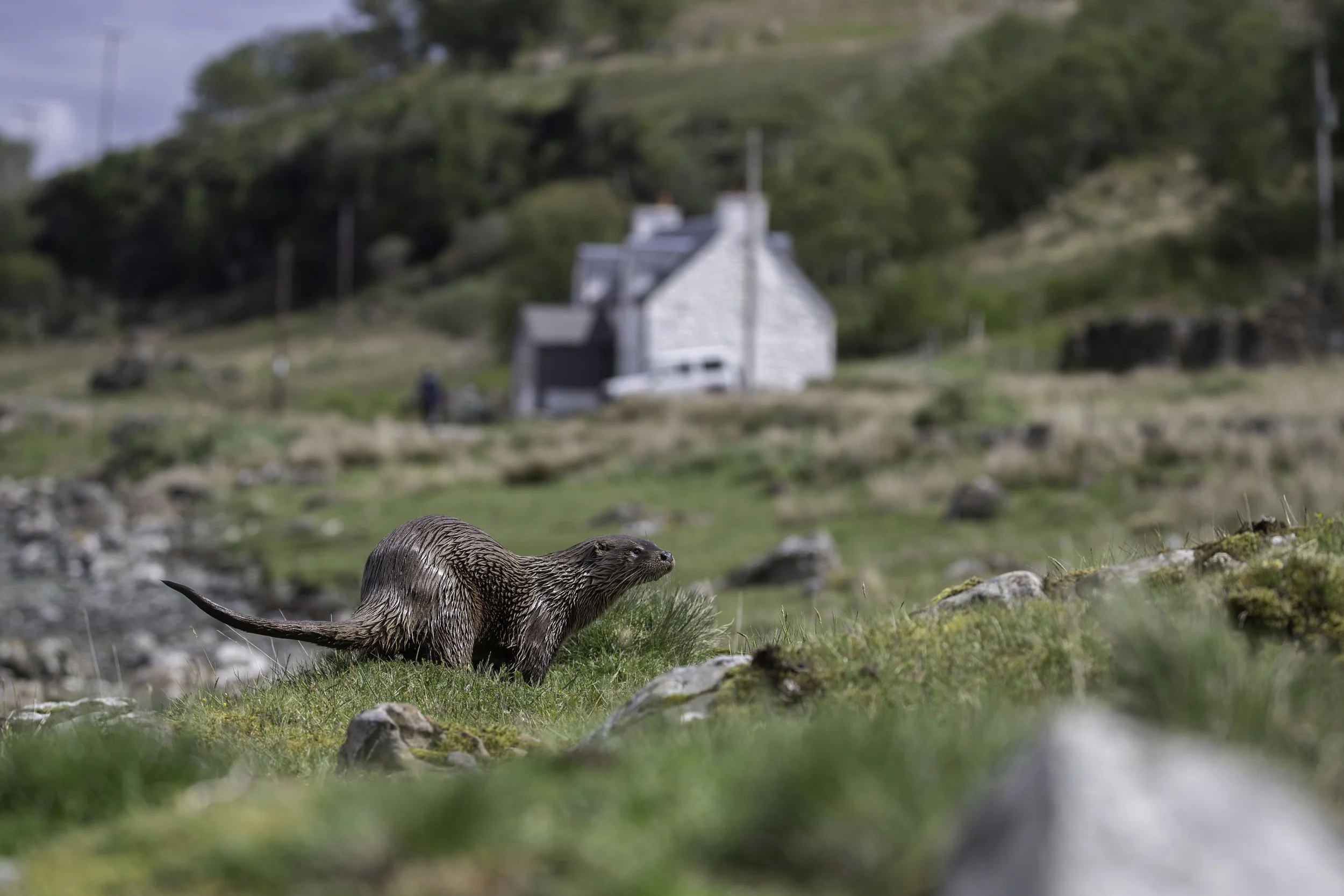
I started taking photographs as the otter made its way across the grass. Among those images is this one.
It definitely isn't my best otter photograph. Technically, compositionally or in terms of the classic wildlife image, there are other photographs I would probably choose before it. But photography isn't always about identifying the single "best" frame. Sometimes an image becomes important because of everything that surrounds the moment it was taken.
And that is exactly how I feel about this photograph.
Look beyond the otter and the scene tells a story.
In the background is the little house, with the car nearby and a person moving around. There is no attempt to remove those elements from the frame, and I wouldn't want to. They help place the photograph. They tell us that this wasn't some remote wilderness untouched by people. This was an otter going about its everyday life alongside the human world.
For me, those background details add a real sense of place.
They make the image unmistakably feel like Mull.
The rocky shoreline, rough grass, boulders, distant hills and small white house all come together to create the setting. The otter isn't isolated against a perfectly blurred background; instead, we see something of the world in which it lives. I think that makes the photograph more personal and, ultimately, more memorable.
What I particularly love about the encounter is that it was a combination of knowledge and luck.
The luck was obvious. We couldn't make the otter appear. We couldn't predict exactly when it would arrive or which route it would take. Wildlife photography will always contain an element of chance.
But luck alone wasn't responsible for the encounter.
We had noticed the signs.
We had recognised what those signs might mean.
We had made the decision to stop rather than simply carry on walking.
And then we had been patient enough to give the opportunity a chance to happen.
That, for me, is one of the most rewarding aspects of photographing wildlife. Knowledge doesn't guarantee success, but it can put you in the right place when luck decides to turn up.
On this occasion, it did.
We sat down with no certainty that we'd see anything, shared some food and conversation, and were rewarded with one of those wonderfully spontaneous wildlife encounters that you couldn't have planned in advance.
The photograph is therefore much more than a picture of an otter to me.
Whenever I look at it, I remember that first year of running workshops on Mull. I remember sitting in the grass, the conversations, the waiting and the quiet anticipation. I remember spotting the signs of otter activity on those boulders and making the decision to stop.
And, most of all, I remember watching this otter come out of the water and casually walk straight past us.
It wasn't my most spectacular otter encounter.
It wasn't my most technically perfect otter photograph.
But it was real, unexpected and unforgettable.
And sometimes, those are the photographs that matter most.