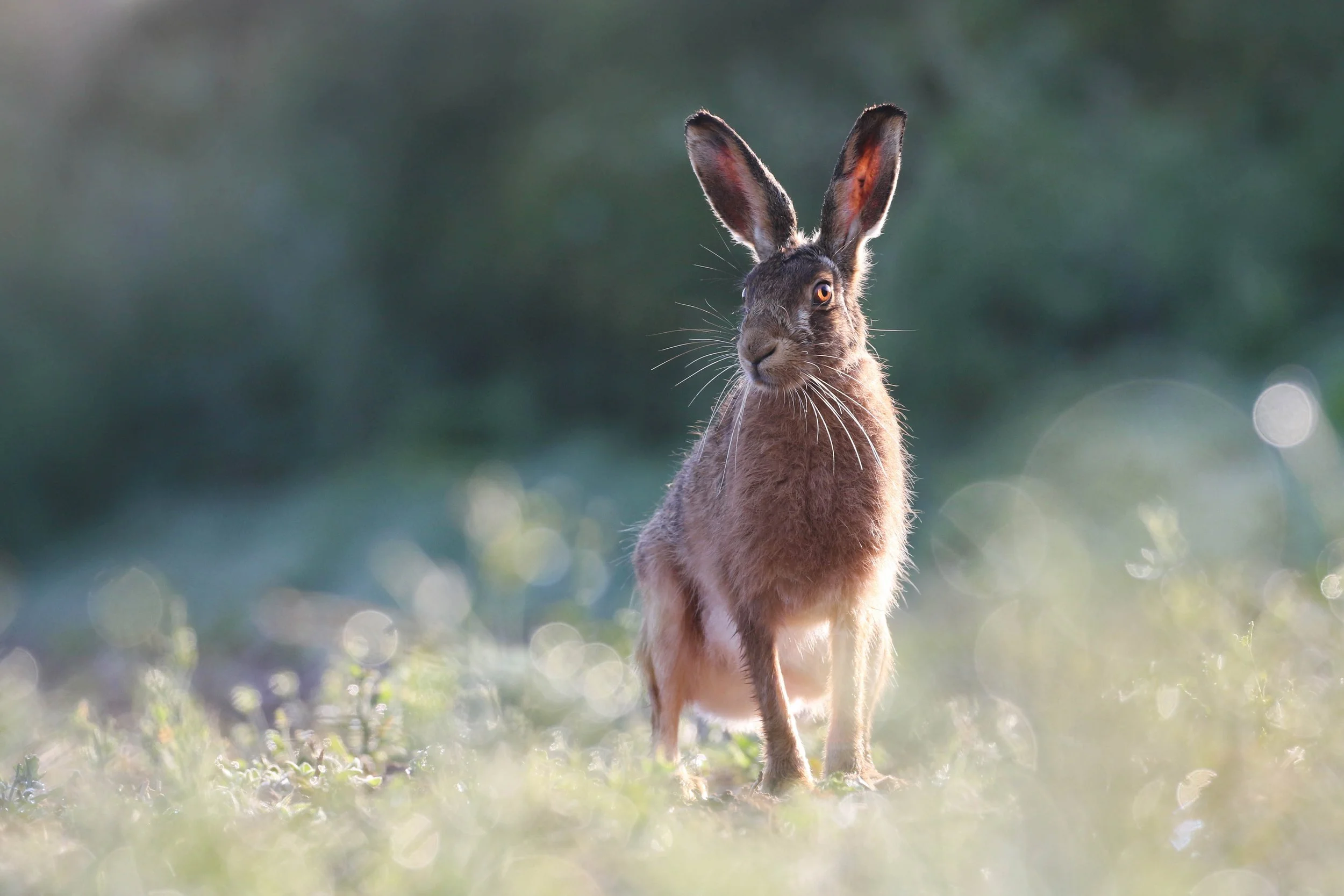
There are some photographs that begin long before the shutter is pressed.
This one began on an overnight ferry, somewhere between Jersey and England, with an old bicycle, a small collection of clothes and my camera. I had no great plan beyond travelling through the country, following whatever wildlife opportunities presented themselves and seeing where the road took me. It was the kind of journey I have always enjoyed most: carrying only what I needed, moving slowly enough to notice things, and never quite knowing what the next day might bring.
I had already made my way through several parts of England. After visiting a friend’s exhibition in Chichester, I had headed towards Surrey in search of deer, before continuing on to Norfolk to catch up with a friend. From there, my route gradually turned north towards Derbyshire and my grandparents’ farm.
I knew I would spend a few days there, but I also knew that the farm offered something I was particularly keen to photograph during this trip: brown hares.
Hares have always had something about them that I find difficult to explain. Perhaps it is their wildness, or the way they seem both completely at home in the landscape and somehow slightly apart from it. They are not animals that simply present themselves to you. They demand patience. You can walk fields for hours and see nothing, then suddenly notice a pair of long ears appearing above the crop some distance away.
During those five days at the farm, I fell into a simple rhythm.
Each morning, before the day had properly begun, I would head out into the fields with my camera. In the evenings, I would do the same as the light softened and the landscape changed colour. I spent hours walking, watching and waiting. Sometimes I found the hares. Sometimes I didn't. But even on the quiet mornings, there was something satisfying about being outside, alone with the landscape, listening to the sounds of the countryside waking around me.
By the fourth day, I had already built up a collection of photographs I was genuinely happy with.
Then came the final morning.
I was due to leave Derbyshire that day and begin the journey south towards Devon. There was, therefore, a slight sense of finality to that morning. I had one last opportunity to go out into the fields before packing up the bicycle and continuing my journey.
The light was beautiful.
The sun was still low, arriving from the side and catching everything at just the right angle. The crops were covered in tiny droplets of water, each one catching the morning light. Through the viewfinder, those droplets transformed into soft circles of light, filling the foreground and background with a hazy, almost dreamlike quality.
It was the sort of morning that makes you want to stay outside for as long as possible.
I found a place along the field margin where I had been photographing hares the morning before and settled down, hoping that something might appear. Lying there quietly, I became part of the edge of the field. There was nothing to do but wait.
And then, eventually, two hares appeared.
They weren't running. They weren't alarmed. They simply lolloped across the field towards me.
With every movement, I tried to remain completely still.
They continued closer.
Closer still.
Eventually, they were only a matter of metres away.
For a wildlife photographer, moments like that can be strangely intense. Your heart is beating faster, but you know you can't move. You don't want to adjust your position, lift your head or make the slightest unnecessary movement. Everything suddenly becomes about remaining unnoticed.
The hares seemed completely unaware of the camera.
They began to graze.
And for perhaps five or ten minutes, nothing else seemed to exist.
There was no journey to Devon. No bicycle waiting to be packed. No ferry, no roads, no plans for the next few days. There was just the field, the morning light, the two hares and the quiet sound of them feeding.
I remember watching the light move across their fur and seeing the tiny droplets on the vegetation sparkle around them. Every time one of the hares lifted its head, I would gently press the shutter. Then I would wait again. The camera became almost an extension of the moment rather than something interrupting it.
Eventually, the hares moved on. As quickly and quietly as they had arrived, they disappeared back into the landscape and I stayed where I was for a little while longer.
There was nothing remarkable about those five or ten minutes in any conventional sense. Nothing dramatic happened. I hadn't discovered some rare species or witnessed an extraordinary event. I had simply been fortunate enough to be in the right place, at the right time, with enough patience to let the moment come to me.
And yet, years later, those few minutes remain with me.
Perhaps that is what I love most about wildlife photography. The photograph is only the evidence. The real memory is everything that happened before and around it: the early morning air, the damp grass, the anticipation, the stillness, the knowledge that at any moment the animals might disappear. This image reminds me of that journey more than any photograph of the road ever could.
I think about the old bicycle, the miles travelled, the friends visited and the places passed through often. I think about arriving at my grandparents' farm and spending five days walking those fields. Most of all, I think about that final morning, when I had already taken photographs I was proud of and could easily have been satisfied with what I had. Instead, I went out one more time and that final morning gave me my favourite images of the trip.
Looking at this photograph now, I can still remember lying there, trying not to breathe too heavily, watching those two hares graze just metres away and for those few minutes, time seemed to stand still.
All I had to do was stay still, remain unnoticed, and press the shutter button (a few hundred times).